

Championships Are Won in the Garage
Display None Text
What Formula 1 can teach us about building high-performance software architecture that remains fast, reliable, and efficient when the pressure is on.

Before AI can understand your business, your business has to understand where its knowledge lives.




Picture a familiar scene.
A leadership team is watching an AI demonstration. The system answers questions, summarizes reports, predicts demand, and recommends what to do next.
For a moment, the future feels close.
Then someone asks:
“Can it do this with our data?”
The room gets quieter.
Customer records live in one platform. Inventory lives in another. Finance has its own numbers. Operations depends on spreadsheets maintained by a few experienced employees. Years of valuable information remain locked inside legacy systems.
The company may be ready to invest in AI.
Its data may not be ready to support it.
AI does not create organizational knowledge. It exposes whether that knowledge has been captured, connected, governed, and made usable.
Most organizations already know their information is fragmented. Employees simply become skilled at compensating for it.
An operations manager knows the inventory report is unreliable after a certain time. Finance knows which spreadsheet contains the corrected numbers. Sales knows that two customer records actually refer to the same company.
People carry context in their heads.
AI does not.
It sees whatever the systems provide.
If one platform says an item is available and another says it has already been allocated, the system may not know which answer reflects reality. If different departments define an “active customer” differently, AI may produce a confident answer to the wrong question.
AI did not create these inconsistencies.
It simply made them harder to ignore.

Almost every established business has data. The more useful question is whether that data can support a reliable decision.
AI-ready data is not simply information copied into the cloud or connected to a model. It must be:
That final point matters.
A dataset can be technically clean and still fail because it excludes exceptions, unusual cases, or the judgment employees apply when the standard process breaks down.
Preparing data for machine learning is therefore not only a technical exercise.
It is an exercise in understanding the business.
When companies discover fragmented business data, they often jump to a massive modernization plan.
Replace everything. Move everything. Centralize everything.
That may eventually be necessary, but it is rarely the best first step.
Begin with one decision.
Suppose the goal is to predict late deliveries. Follow that decision backwards. The system may need order history, supplier performance, warehouse availability, shipping routes, seasonal conditions, and past delays.
Now ask:
This creates a practical data foundation for AI around a measurable outcome.
Many data problems are really definition problems.
Consider the word “customer.”
Sales may include anyone with an active opportunity. Finance may recognize a customer only after an invoice is issued. Support may include former customers with active agreements.
Each definition may make sense within its department.
An AI system cannot use all three without context.
The same problem appears with:
A serious AI data strategy requires clear ownership.
Someone must decide which definition applies, which system is authoritative, and how conflicts will be resolved.
Without that agreement, AI does not create a single source of truth.
It creates a faster way to distribute competing ones.
Historical cleanup matters.
Duplicates must be resolved. Dates, currencies, formats, and measurement units may need to be standardized. Missing values and conflicting records must be addressed.
But cleaning data once is not enough.
Data quality immediately begins to decay again. Employees enter information differently. Vendors change formats. Systems evolve. Teams create new categories and business rules.
The real work of data engineering for AI is not only correcting the past. It is building pipelines that prevent the same problems from returning.
That may include validation rules, entity matching, automated quality checks, duplicate detection, and alerts when data falls outside acceptable thresholds.
A manually cleaned dataset can support an impressive demonstration.
A reliable pipeline supports a real product.
Older systems are often treated as obstacles to AI.
Sometimes they are.
Sometimes they contain decades of customer behaviour, supplier history, pricing information, maintenance records, and operational decisions that cannot be recreated.
Legacy data modernization does not always require full replacement. It may involve APIs, middleware, scheduled pipelines, database-change capture, or controlled synchronization.
The goal is not to make every system look modern.
The goal is to make valuable information safely usable.
This principle shaped Wewer’s work with Deko Automotive. More than 25 years of inventory, logistics, supply-chain, and operational information existed across fragmented systems.
The opportunity was not simply to add AI.
It was to consolidate that history into a stronger foundation for future AI and LLM-driven use cases.
Historical depth creates potential.
Structure creates value.
At MetaworldX, more than 75 data sources and over 100 APIs connected IoT devices, building systems, weather information, and cloud infrastructure.
The challenge was not just scale.
It was coordination.
Each source operated at a different speed, with different formats and reliability levels. The value came from unifying that information into an operational system while reducing cloud costs by approximately 75%.
Global Dollar Analytics presented another form of the same problem. More than 20 years of market information supported a proprietary machine-learning prediction engine.
The historical depth mattered only because the information could be processed consistently, tested across changing conditions, and delivered through reliable infrastructure.
Across automotive operations, smart buildings, and financial markets, the principle remains the same:
Raw data is not intelligence. Connected, contextualized, and evaluated data can become intelligence.
Not every AI system needs real-time data.
A forecasting model may work with daily updates. An internal knowledge assistant may only need documents synchronized several times a day. Historical analysis may gain nothing from continuous streaming.
Other workflows cannot tolerate delay.
Fraud detection, inventory availability, live building monitoring, or an AI agent taking immediate action may require current information.
The right question is:
How old can this data become before the decision becomes wrong?
That answer should determine whether the system uses batch processing, scheduled synchronization, event streams, or real-time access.
Real-time infrastructure is not automatically better.
Sometimes it is simply more expensive.
Once data is connected, permissions become critical.
An employee assistant should not reveal executive compensation because it can search the same repository. A customer-service system should not retrieve another customer’s information. A development environment should not expose unrestricted production records.
A credible enterprise AI infrastructure requires:
These controls must exist in the architecture.
A prompt saying “do not reveal sensitive information” is not a security boundary.
Organizations often evaluate AI through polished demonstrations and a handful of convenient questions.
That measures presentation quality, not production readiness.
Before selecting the model, create a representative evaluation set containing:
This creates a measurable definition of success.
Without evaluation data, teams tend to choose the model that produces the most impressive answer in the room.
With it, they can choose the system that performs most reliably in the business.
The first AI initiative should not try to transform the entire organization.
Choose one workflow with clear ownership, accessible data, manageable risk, and a measurable outcome.
It might classify requests, answer employee questions, predict delays, detect anomalies, or recommend the next step in a defined process.
A contained use case creates value while exposing how the business actually works: unofficial spreadsheets, hidden approvals, undocumented exceptions, and the judgment employees apply every day.
The first implementation should do two things:

The most important work in AI is often invisible.
It is the definition that every department agrees on. The validation rule that catches a duplicate. The permission boundary that protects sensitive information. The integration layer that unlocks decades of operational history.
These elements may not create the excitement of an AI demonstration.
They create something more valuable.
Reliability.
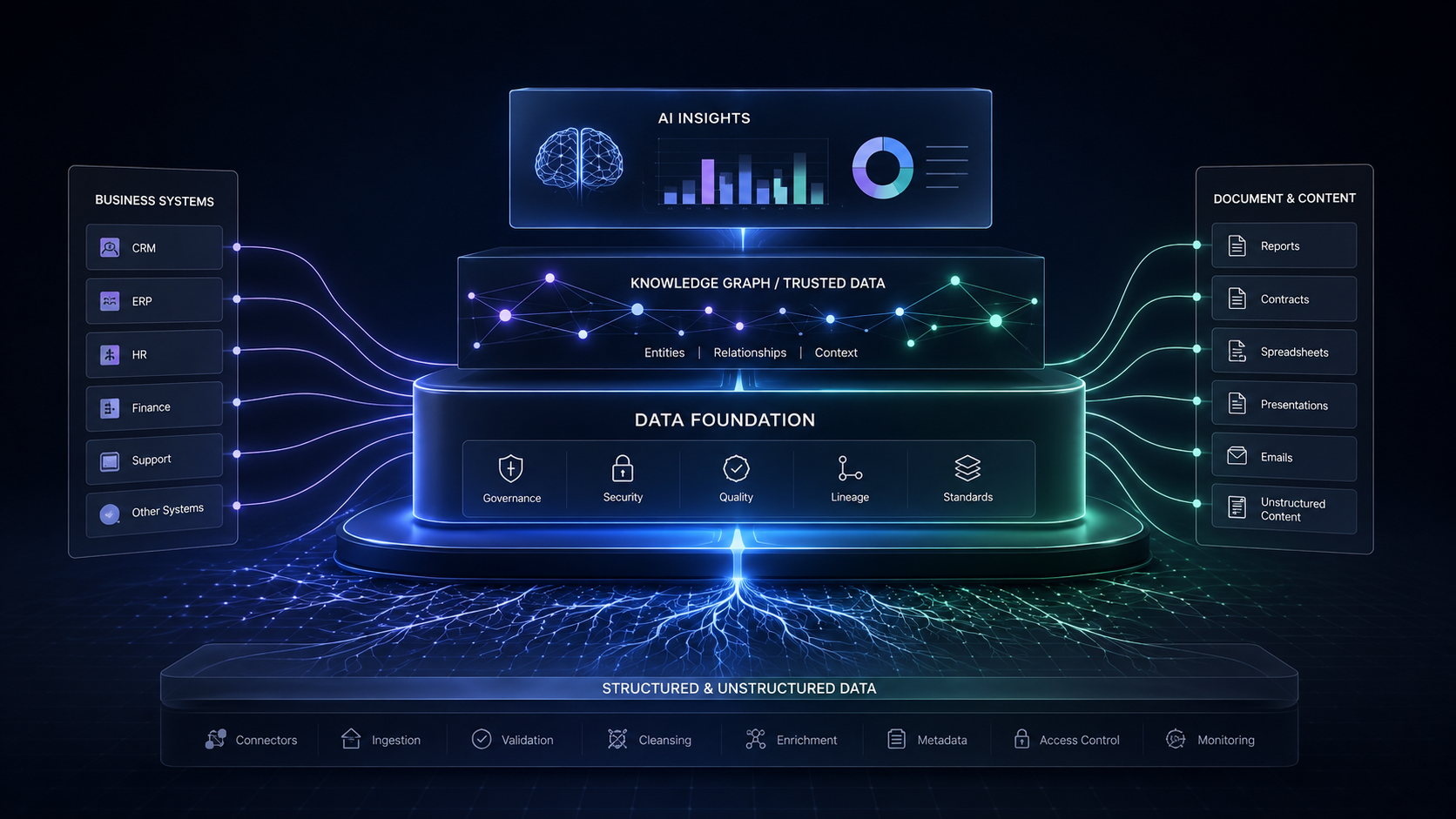
The businesses that gain the most from AI will not necessarily be those using the most fashionable model. They will be the ones that connect the right information, preserve its context, enforce its boundaries, and measure whether the system is actually working.
Before asking which AI platform to buy, ask a more important question:
Can your data support the decisions, actions, and outcomes you expect AI to deliver?

What Formula 1 can teach us about building high-performance software architecture that remains fast, reliable, and efficient when the pressure is on.

The strongest systems are rarely made from extraordinary parts. They become extraordinary through the way those parts are connected.

The real test of an AI system begins when the perfect prompt, curated data, and friendly audience disappear.

Before AI can understand your business, your business has to understand where its knowledge lives.
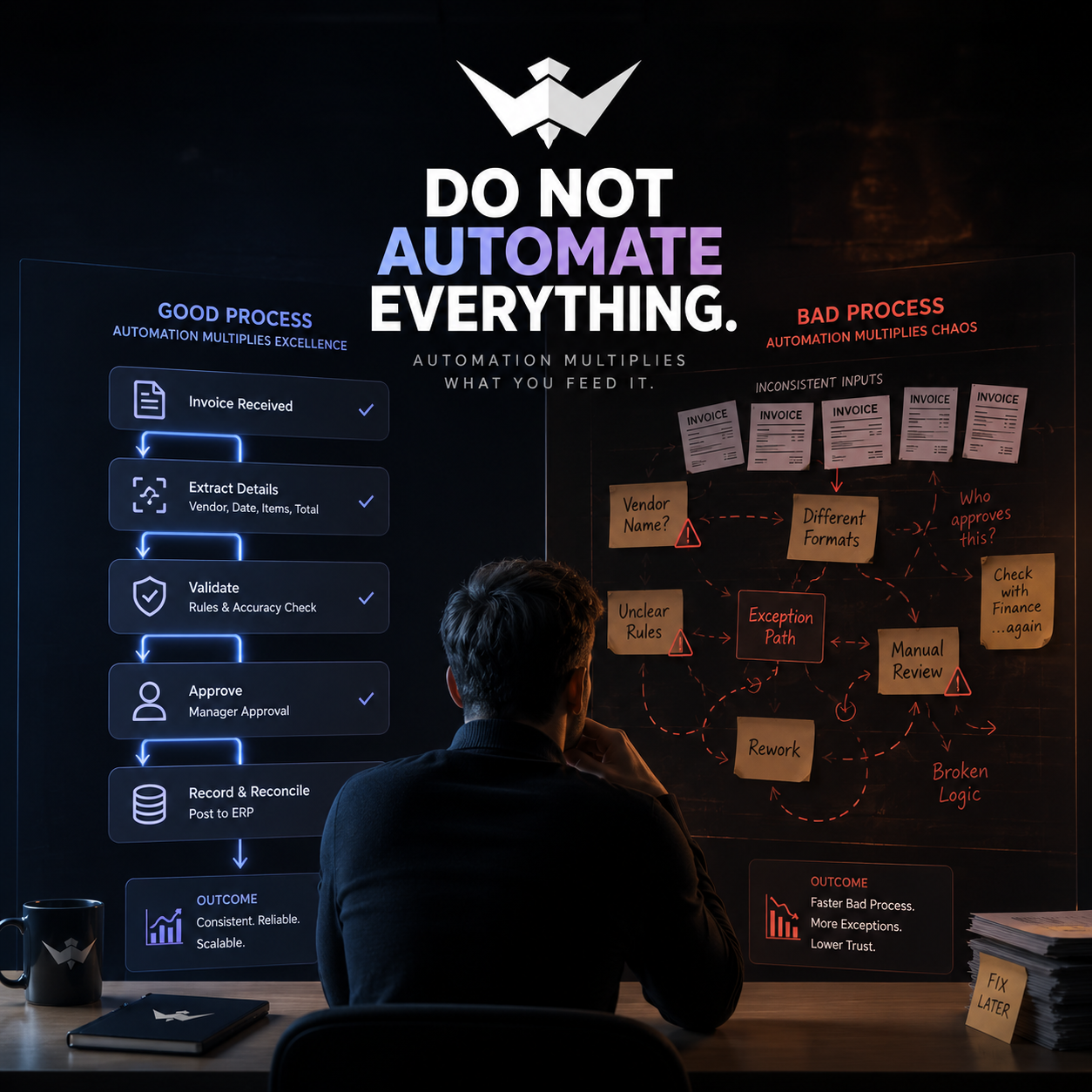
Automation is a multiplier. Before making a process faster, make sure it deserves to be multiplied.

We learned to talk to artificial intelligence. Now we are teaching it how to move work forward.
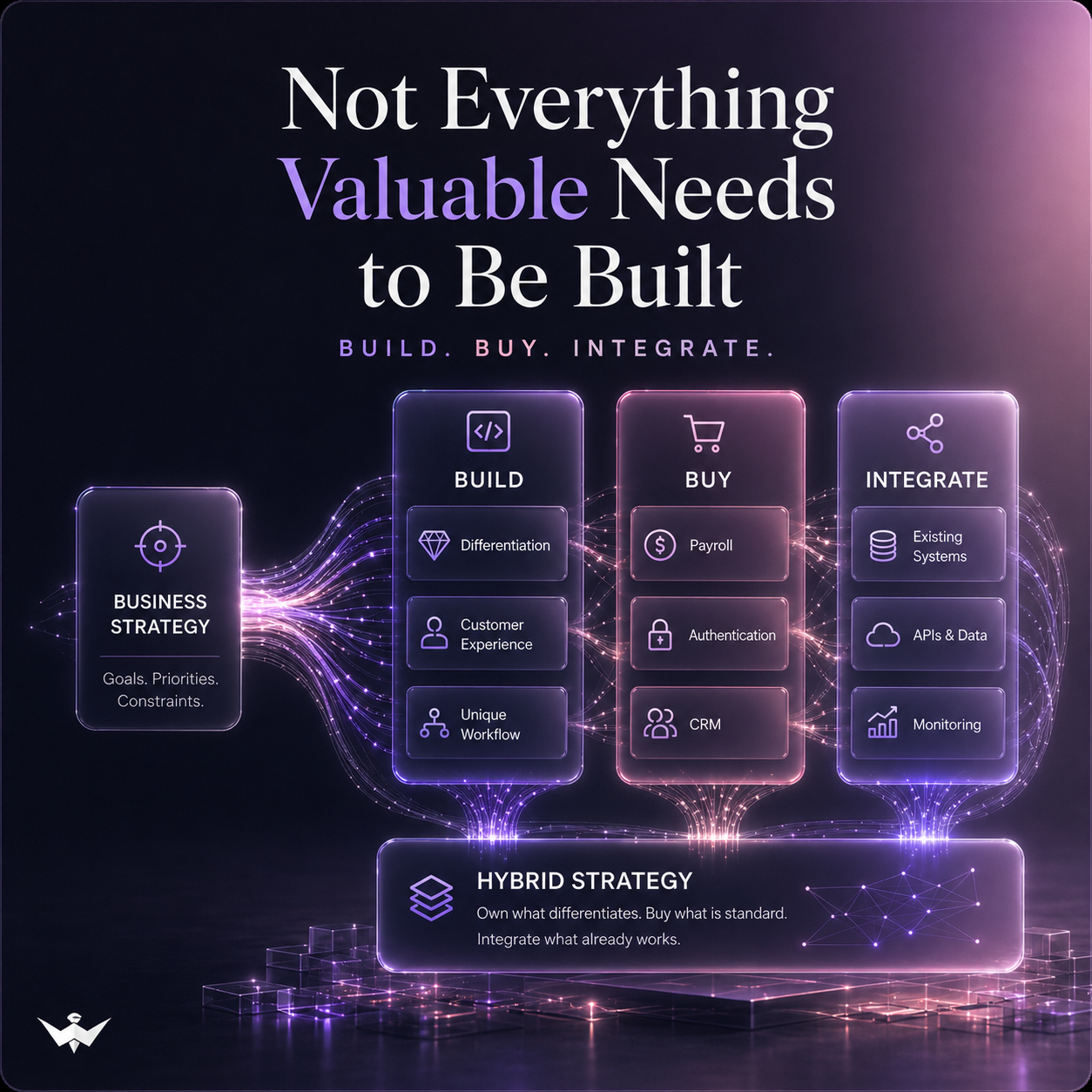
The smartest software strategy is not choosing between build and buy-it is knowing what your business should own, what it should borrow, and what it should connect.