
Championships Are Won in the Garage
Display None Text
What Formula 1 can teach us about building high-performance software architecture that remains fast, reliable, and efficient when the pressure is on.

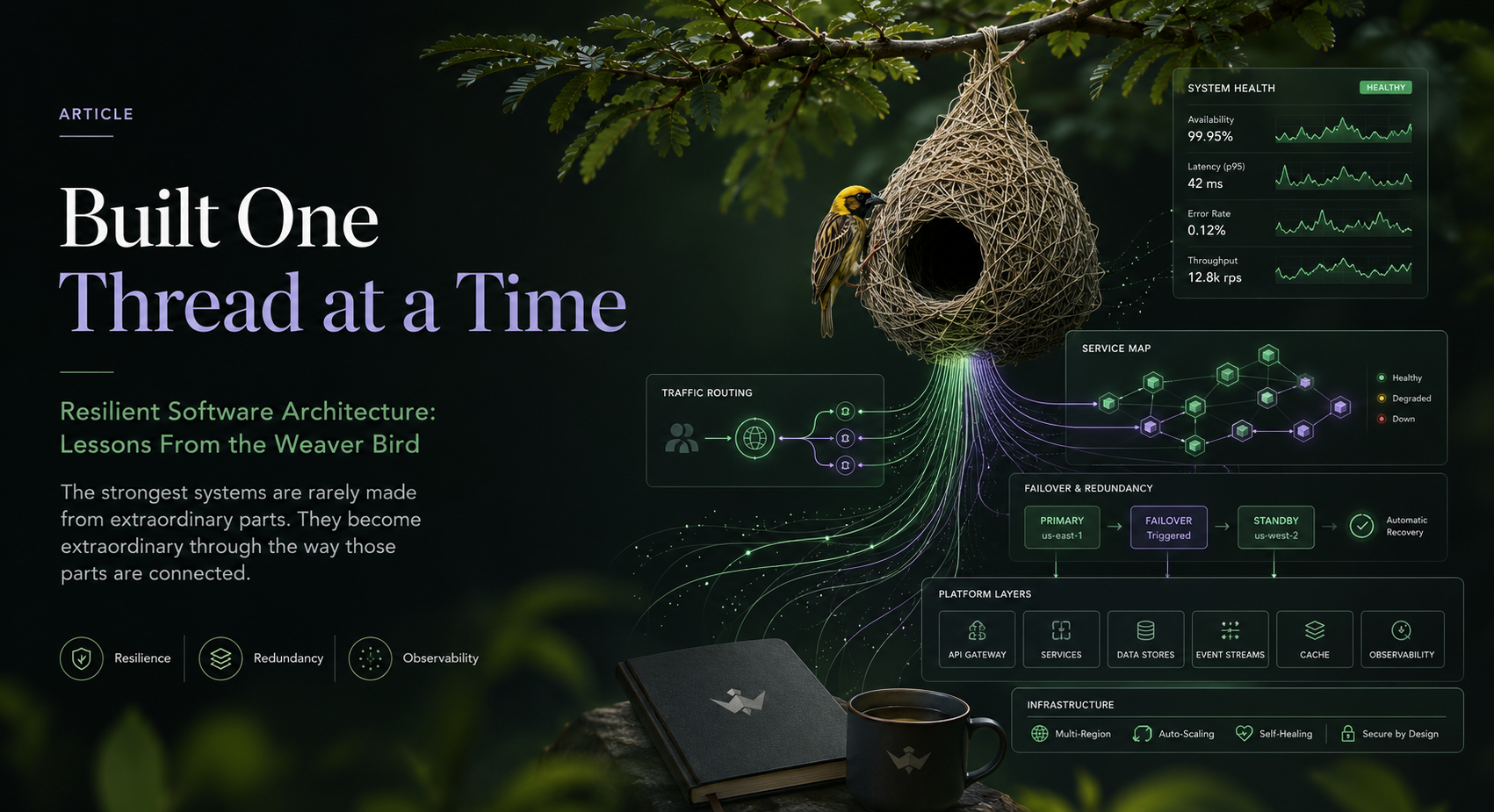
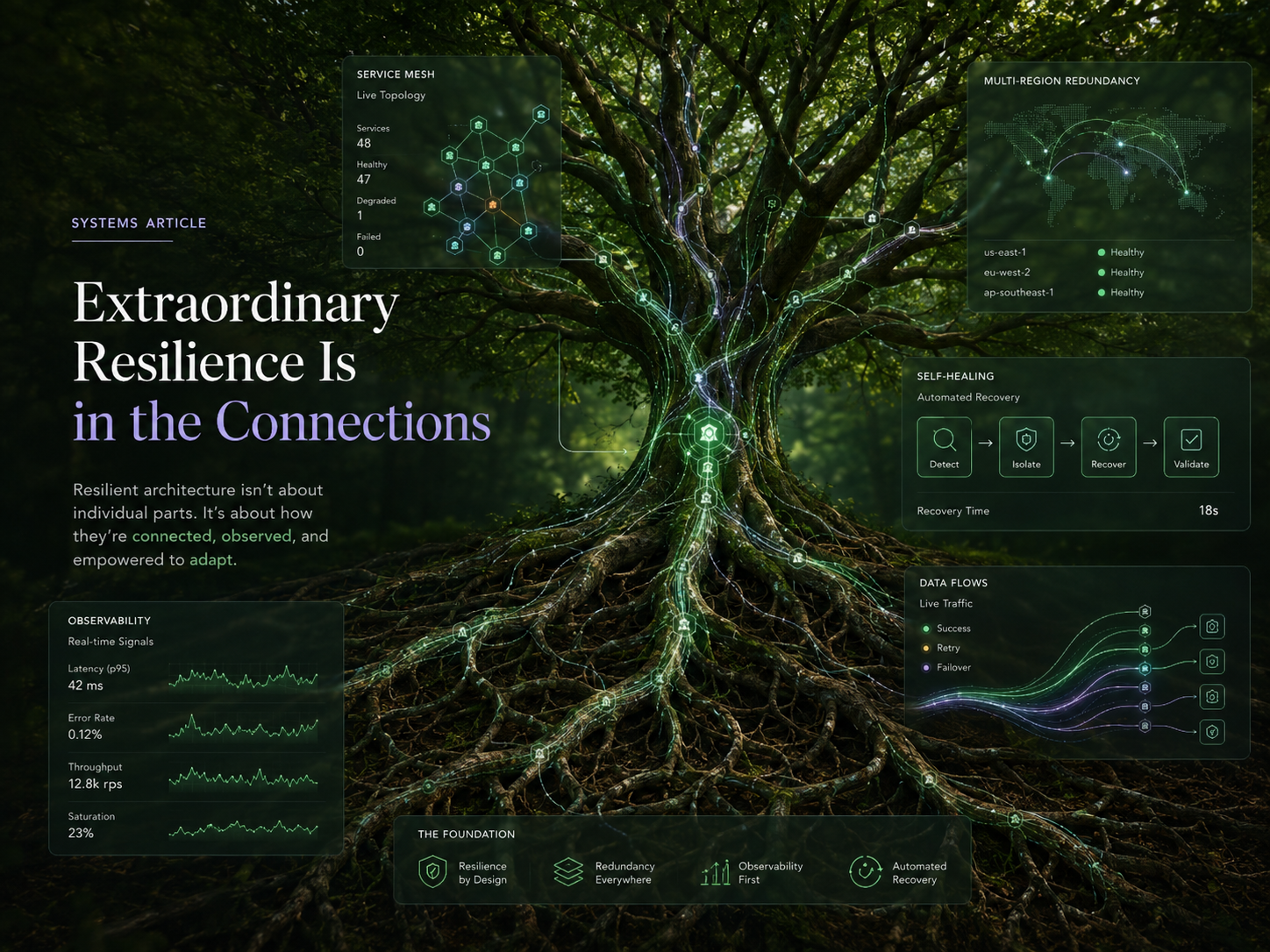
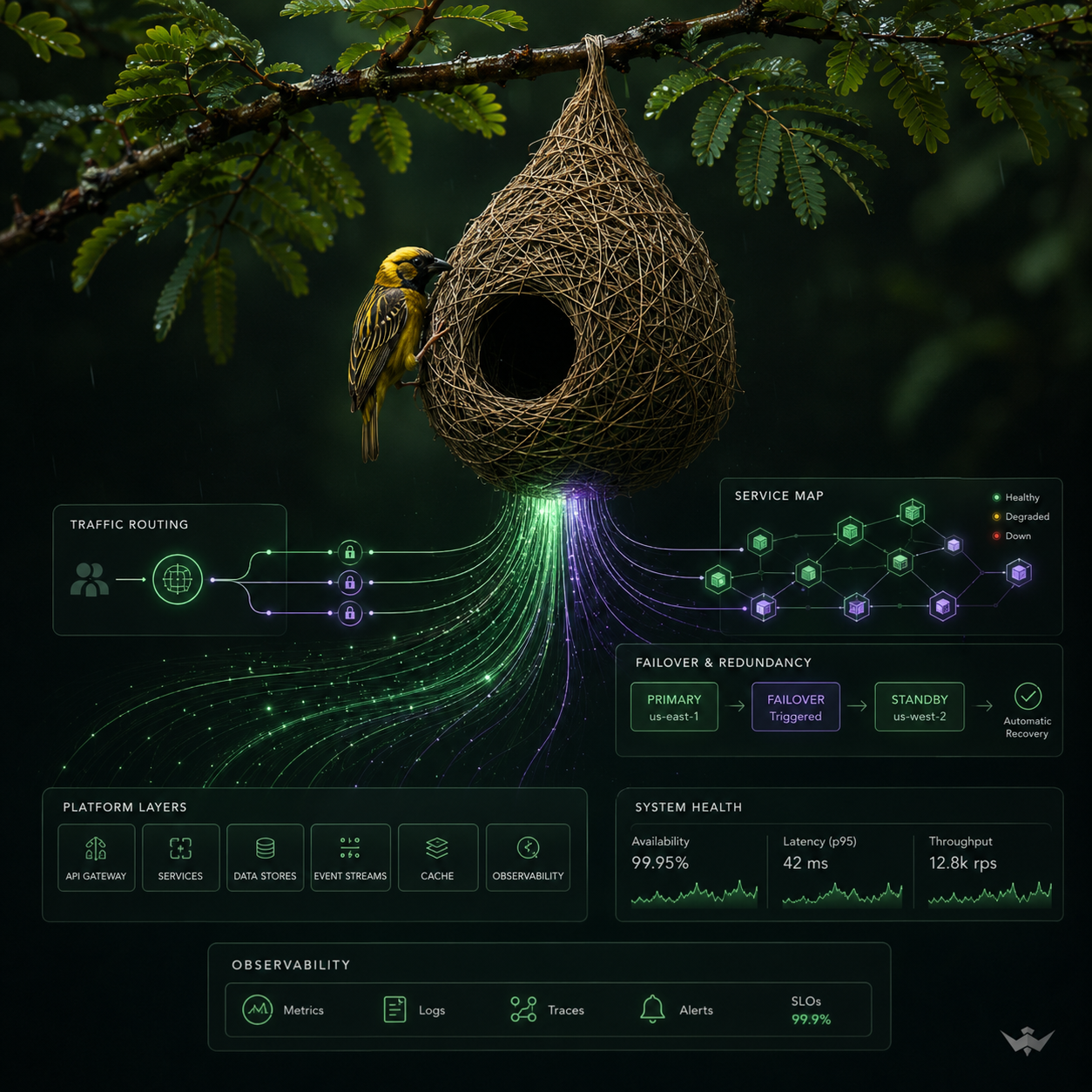
The strongest systems are rarely made from extraordinary parts. They become extraordinary through the way those parts are connected.



There is a moment, early in the construction of a weaver bird’s nest, when the whole thing looks almost impossible.
A thin blade of grass hangs from a branch. Then another is looped through it. The beginnings of the nest sway freely in the wind, appearing too delicate to carry anything at all. There are no walls, no shelter, and no obvious sign that these scattered fibres will eventually become a home.
But the bird continues.
It pulls one strand through another, tightens a loop, tests the tension, and returns with more material. Some fibres bend. Others break. A few are discarded. Slowly, a structure begins to appear where none existed before.
What makes the nest remarkable is not the strength of any single thread. Most of the materials are ordinary: grass, leaves, plant fibres, and whatever else the environment offers.
The strength comes from the weave.
That idea has stayed close to us at Wewer because modern software is built in much the same way.
An API is only a thread. A database is only a thread. A cloud service, an automation, an AI model, or a dashboard-each can be useful on its own, but none of them creates a resilient platform by itself.
Resilience emerges from the relationships between them.
When a digital product works well, we notice what is visible.
We notice how quickly the page loads. We notice that the dashboard feels effortless. We notice that a payment goes through, a recommendation appears, or a report is generated when we ask for it.
What we rarely notice is the architecture underneath.
We do not see the identity service confirming who we are, the database retrieving the right information, the background workers processing tasks, the monitoring systems checking for failure, or the integrations communicating with platforms outside the company.
To the user, the experience feels like one product.
Behind the interface, it may be dozens of moving parts.
This is where many software projects go wrong. Teams spend enormous energy choosing the best individual technologies, but far less time thinking about what happens between them.
They select a powerful database, a modern framework, a respected cloud provider, and a collection of capable services. Then they assume that good components will naturally produce a good system.
They do not.
A basket full of strong fibres is not a nest.
The architecture begins when those fibres are connected with intention.
A service may work perfectly when tested alone. A database may perform exactly as expected. An API may return the correct response thousands of times.
Then the system enters the real world.
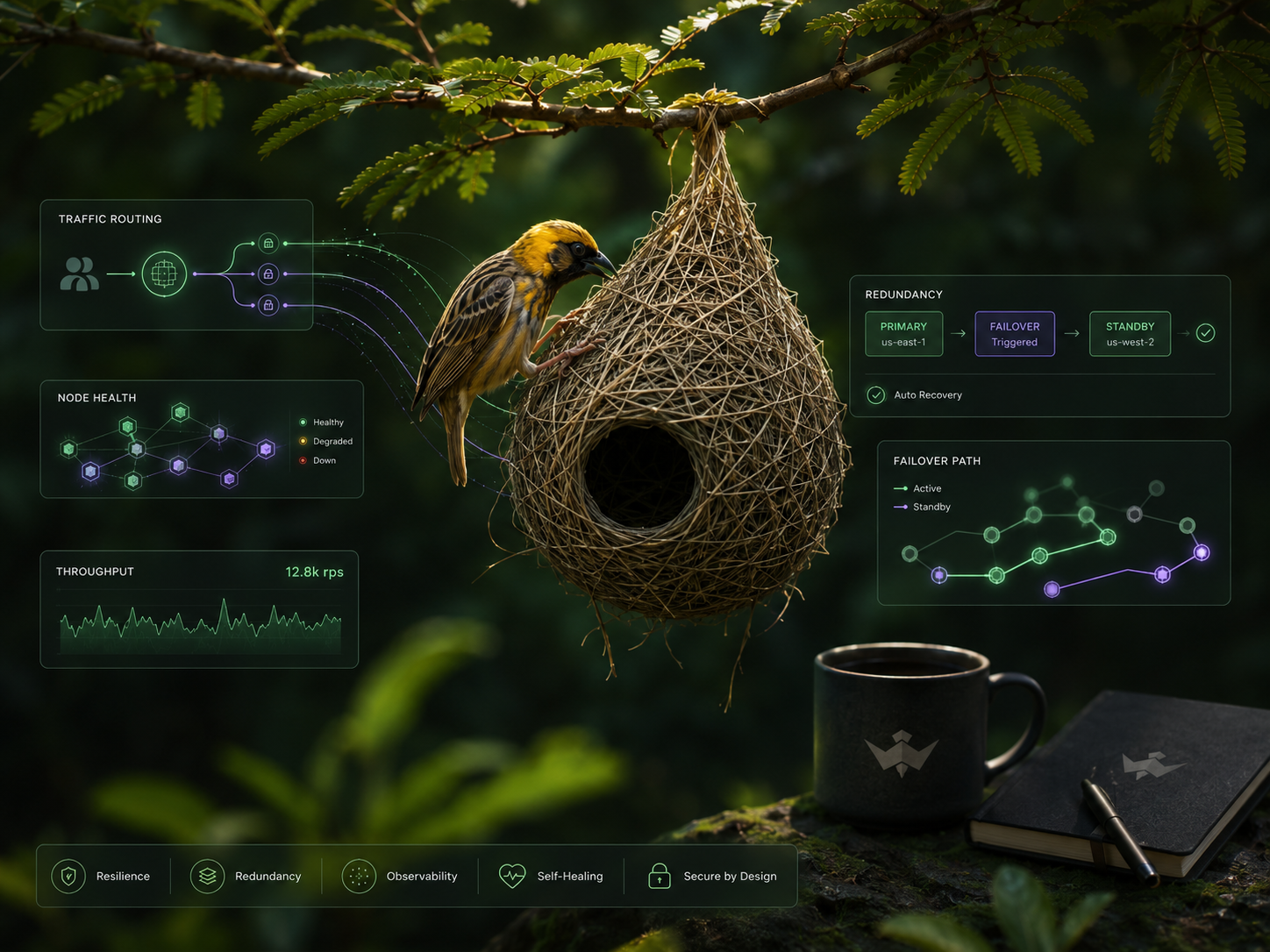
A request times out after the database has already saved the information. The user tries again, and the same transaction is created twice. A third-party API slows down, causing other services to wait. Those services begin retrying, generating more traffic and making the original problem worse. One small disruption moves through the platform until the entire experience begins to fail.
No single component was necessarily broken.
The connections were not prepared for pressure.
This is the heart of resilient software architecture. It is not simply about preventing failure. Failure will happen. Networks will become unreliable. Vendors will have outages. Deployments will go wrong. Data will arrive in unexpected shapes. Usage will grow in ways nobody predicted.
The real question is: what happens next?
A resilient system should be able to answer three things clearly:
These questions are not glamorous. They rarely appear in a product demo. But they determine whether a platform can be trusted after the excitement of launch has passed.
The weaver bird does not build as though the air will remain still.
The nest hangs outdoors. It will face wind, rain, movement, and the constant pull of gravity. A rigid structure might appear strong at first, but rigidity can become a weakness when conditions change.
The nest survives because it can move. Pressure is distributed across many strands instead of being concentrated in one place.
Good systems behave similarly.
They are designed with the assumption that conditions will change. Traffic may suddenly multiply. A supplier may alter its API. A business may expand into a new market. A system built for one team may eventually be used across an entire organisation.
Resilience therefore requires more than backup servers. It requires adaptability.
Sometimes that means using queues so work can wait safely when another service is unavailable. Sometimes it means isolating a non-critical feature so the main product can continue operating without it. Sometimes it means building clear boundaries so one part of the platform can change without forcing every other part to change with it.
This is also why modularity matters.
A modular system is not necessarily a collection of hundreds of microservices. In fact, dividing a platform too early can create more fragility, not less. Every new service introduces another network connection, another deployment, another dependency, and another place where something can go wrong.
The goal is not to create as many parts as possible.
The goal is to make change manageable.
A strong module has a clear responsibility. It can be understood, tested, replaced, or expanded without pulling apart the rest of the system. That is what allows software to evolve without requiring a complete rebuild every few years.
True scalability is not only the ability to serve more users.
It is the ability to absorb more change.
In business, duplication is often treated as inefficiency.
Why run multiple application instances when one can handle today’s traffic? Why maintain backups that may never be needed? Why create an alternative path when the main path works almost all the time?
Because “almost all the time” is not the same as reliable.
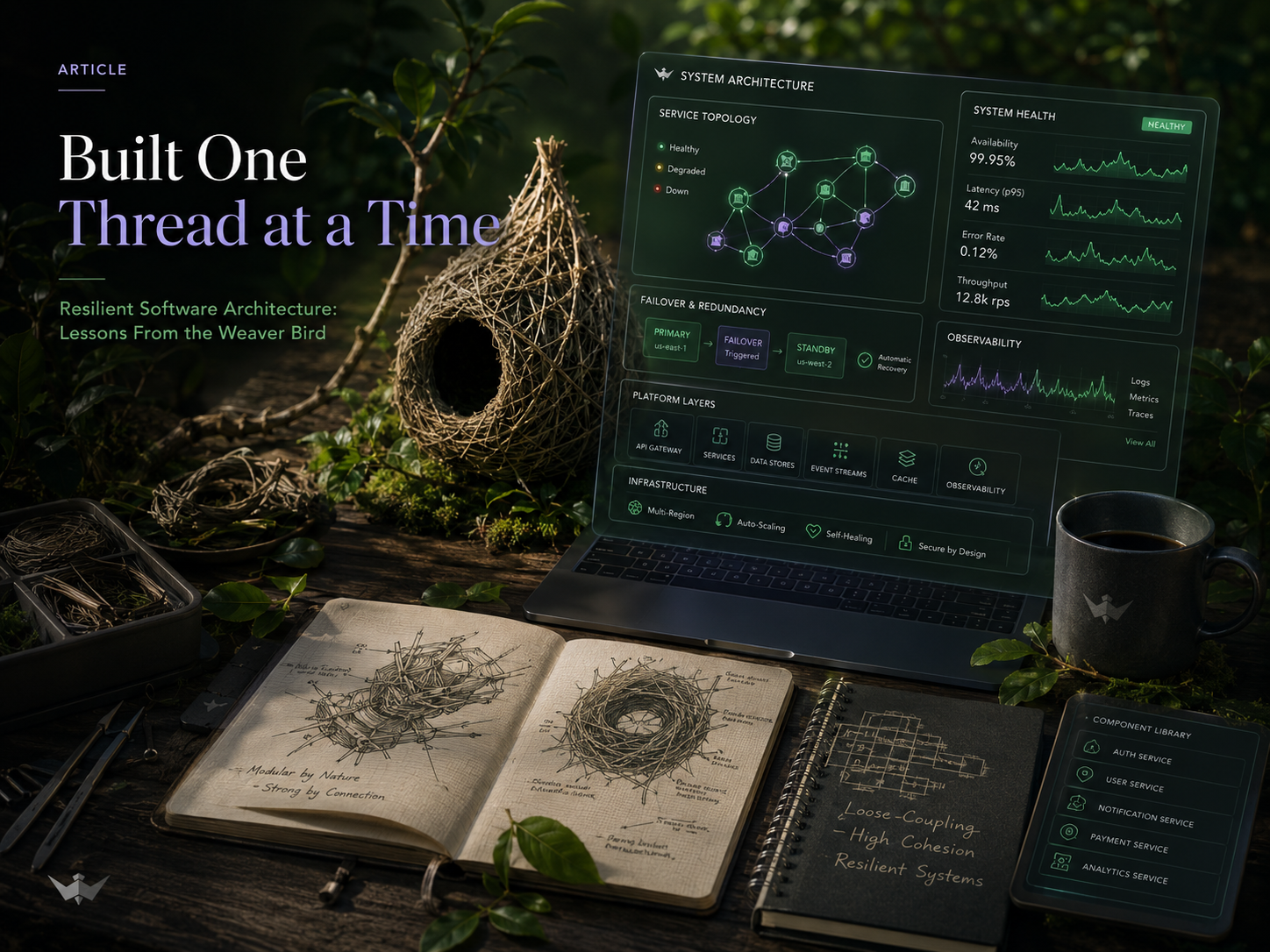
The weaver bird does not allow one fibre to carry the entire nest. Important sections overlap. Weak areas receive more material. Multiple strands share the load.
In software, thoughtful redundancy may involve replicated data, multiple service instances, recovery environments, backup communication paths, or the ability to continue with limited functionality when one dependency fails.
But redundancy has to solve a real problem.
Two systems hosted in different places are not truly independent if both depend on the same underlying provider. A backup has little value if nobody has tested whether it can be restored. A second process can create more confusion if ownership is unclear.
The purpose is not to duplicate everything. It is to identify which parts carry the greatest weight and reinforce them accordingly.
That is the difference between complexity and resilience.
Before weaving begins, the bird must choose an anchor.
The branch is not the most impressive part of the nest, but every fibre depends on it. A perfectly woven structure attached to a weak foundation is still a weak structure.
Software inherits the limits of its foundation too.
A polished interface cannot compensate for a confused data model. More infrastructure cannot fix unclear ownership. An advanced AI system cannot produce dependable outcomes from inconsistent, poorly governed information. Monitoring tools cannot explain a workflow that was never designed to be observable.
The foundations of reliable software are often invisible:
These are the parts of technology that businesses rarely celebrate. Yet when they are missing, every visible feature becomes harder to maintain.
Strong foundations do not predict every future requirement. They do something more valuable: they leave room for the future to arrive.
The philosophy of weaving systems together is not only a metaphor for us. It reflects the practical challenge behind much of our work.
With MetaworldX, the challenge involved more than 100 APIs and over 75 data sources. None of those integrations created meaningful value in isolation. The value appeared when they could operate as one connected ecosystem-when information could move reliably, services could coordinate, and the wider platform could remain understandable despite its scale.
With Deko Automotive, the starting point was more than 25 years of business information spread across different systems and formats. The task was not simply to migrate old records into a modern database. It was to give decades of operational knowledge a structure that could support analytics, automation, and future AI capabilities.
These projects belonged to different industries and involved very different technologies.
Yet the underlying problem was the same.
How do you take many individual capabilities and turn them into one system that people can depend on?
The answer was never one perfect technology.
It was the architecture of the connections.
There is another truth about software that becomes clearer over time: systems remember how they were built.
They remember the rushed workaround that was supposed to last one week. They remember the integration nobody documented. They remember the database field whose meaning changed three times. They remember the decision to postpone monitoring until after launch.
Every decision becomes another strand in the structure.
Some strengthen it. Others become knots that future teams must spend months trying to untangle.
This is why resilience is not only a technical quality. It is also an organisational habit.
It comes from teams that treat documentation, testing, observability, maintenance, and recovery as part of the product-not as work to be considered after the “real” features are finished.
The systems businesses depend on every day are rarely held together by one brilliant technical decision. They are held together by hundreds of careful, often invisible choices made consistently over time.
At the beginning, the weaver bird has no nest.
It has a branch, a strand of grass, and the instinct to begin.
One loop becomes an anchor. The next gives it shape. More fibres add strength. Weak areas are reinforced. The structure adapts as it grows.
Eventually, something fragile becomes dependable.
That is how resilient software is built too.
Not through one cloud provider, one framework, or one perfect architecture diagram. It is built through clear boundaries, reliable connections, thoughtful reinforcement, strong foundations, and the discipline to prepare for pressures that have not arrived yet.
One decision at a time.
One connection at a time.
One thread at a time.
Because the strongest systems are not the ones that never face the wind.
They are the ones designed to keep holding when it comes.

What Formula 1 can teach us about building high-performance software architecture that remains fast, reliable, and efficient when the pressure is on.
The strongest systems are rarely made from extraordinary parts. They become extraordinary through the way those parts are connected.
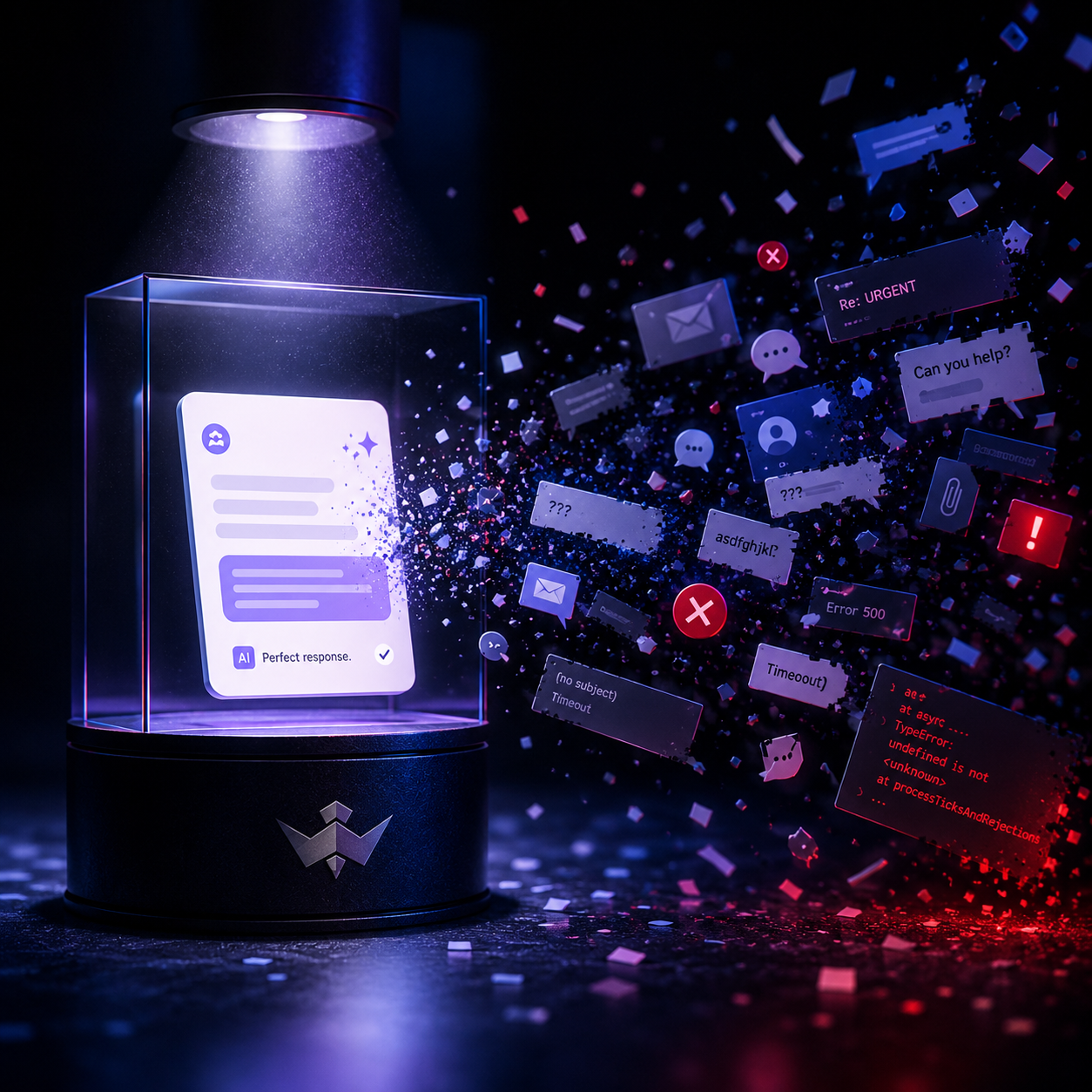
The real test of an AI system begins when the perfect prompt, curated data, and friendly audience disappear.
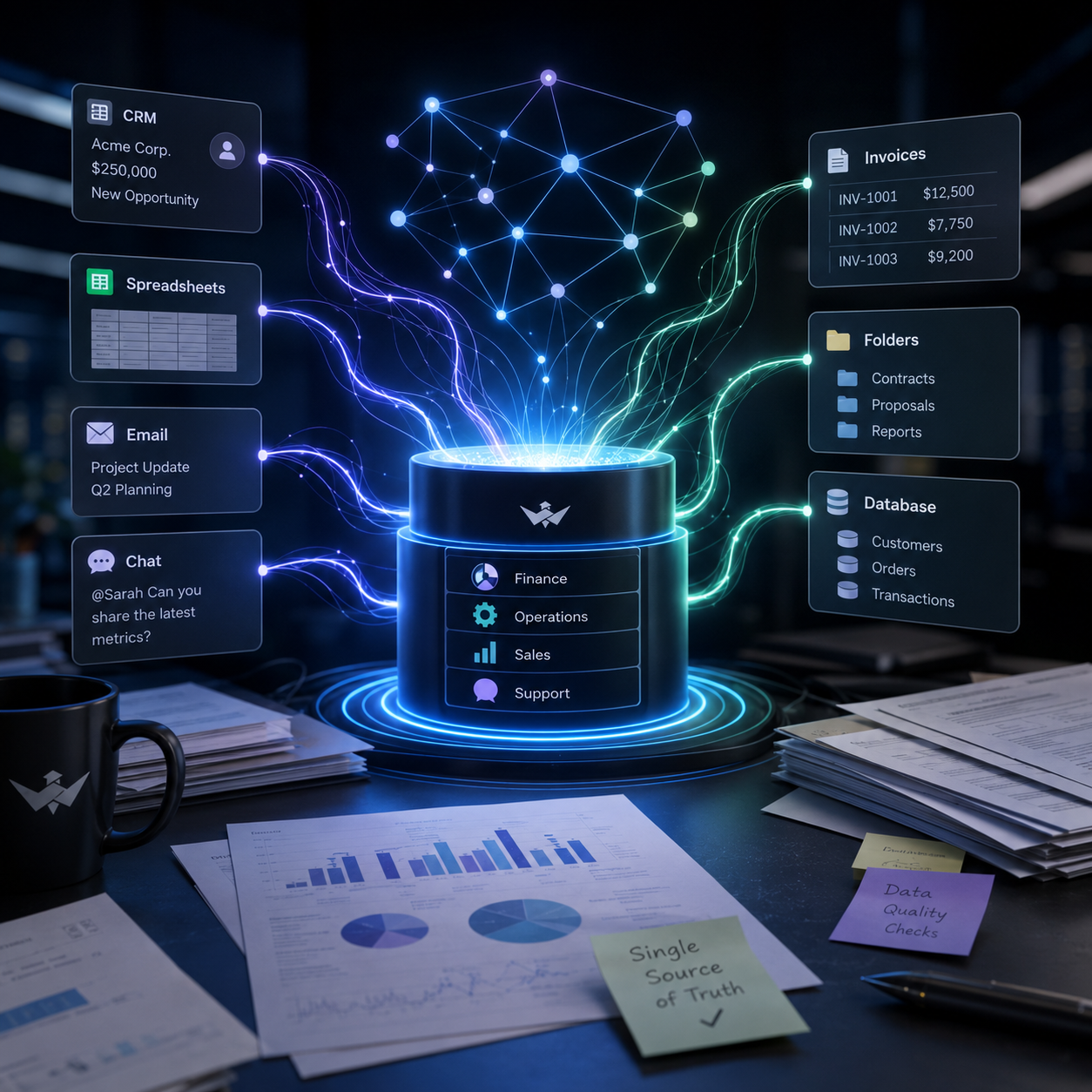
Before AI can understand your business, your business has to understand where its knowledge lives.
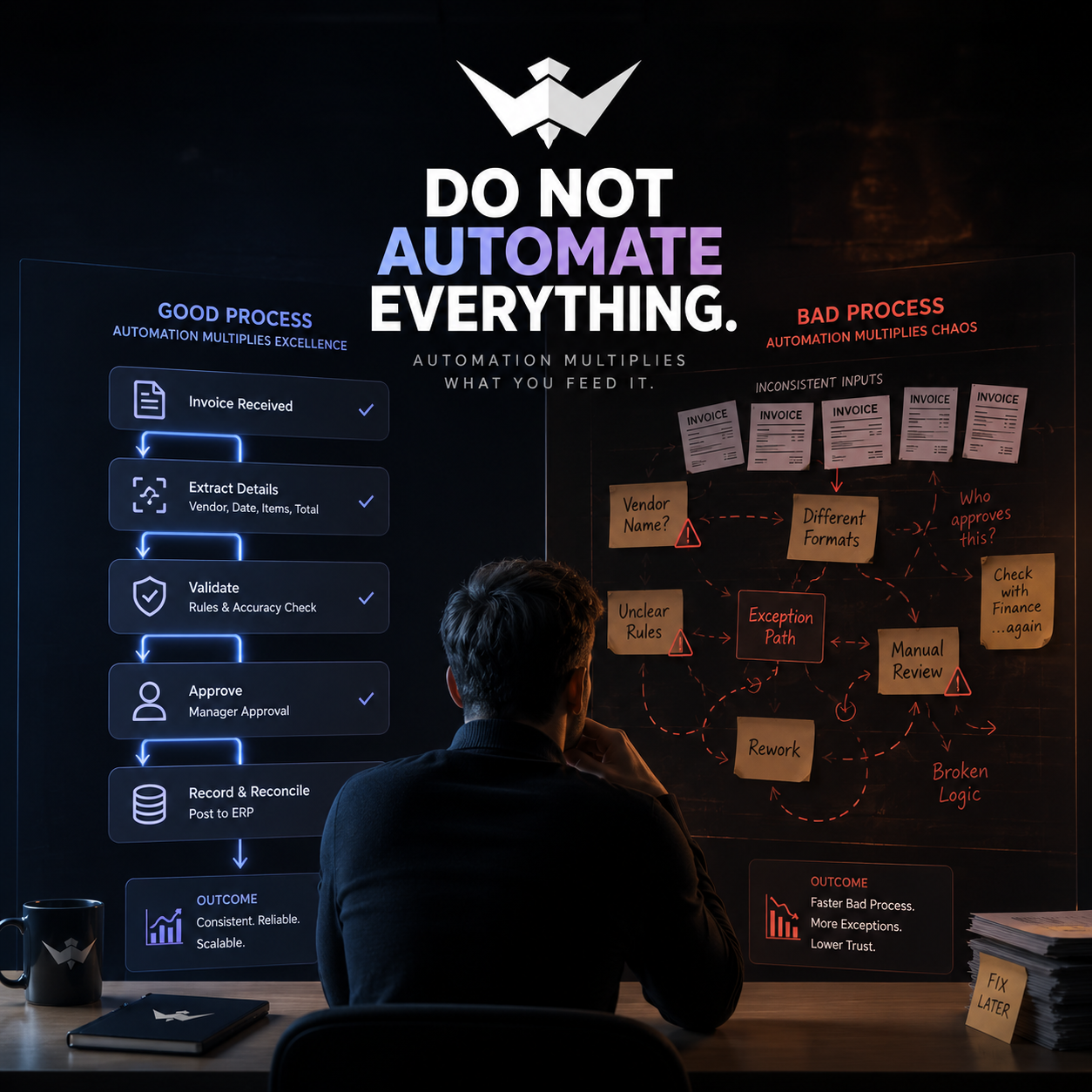
Automation is a multiplier. Before making a process faster, make sure it deserves to be multiplied.

We learned to talk to artificial intelligence. Now we are teaching it how to move work forward.
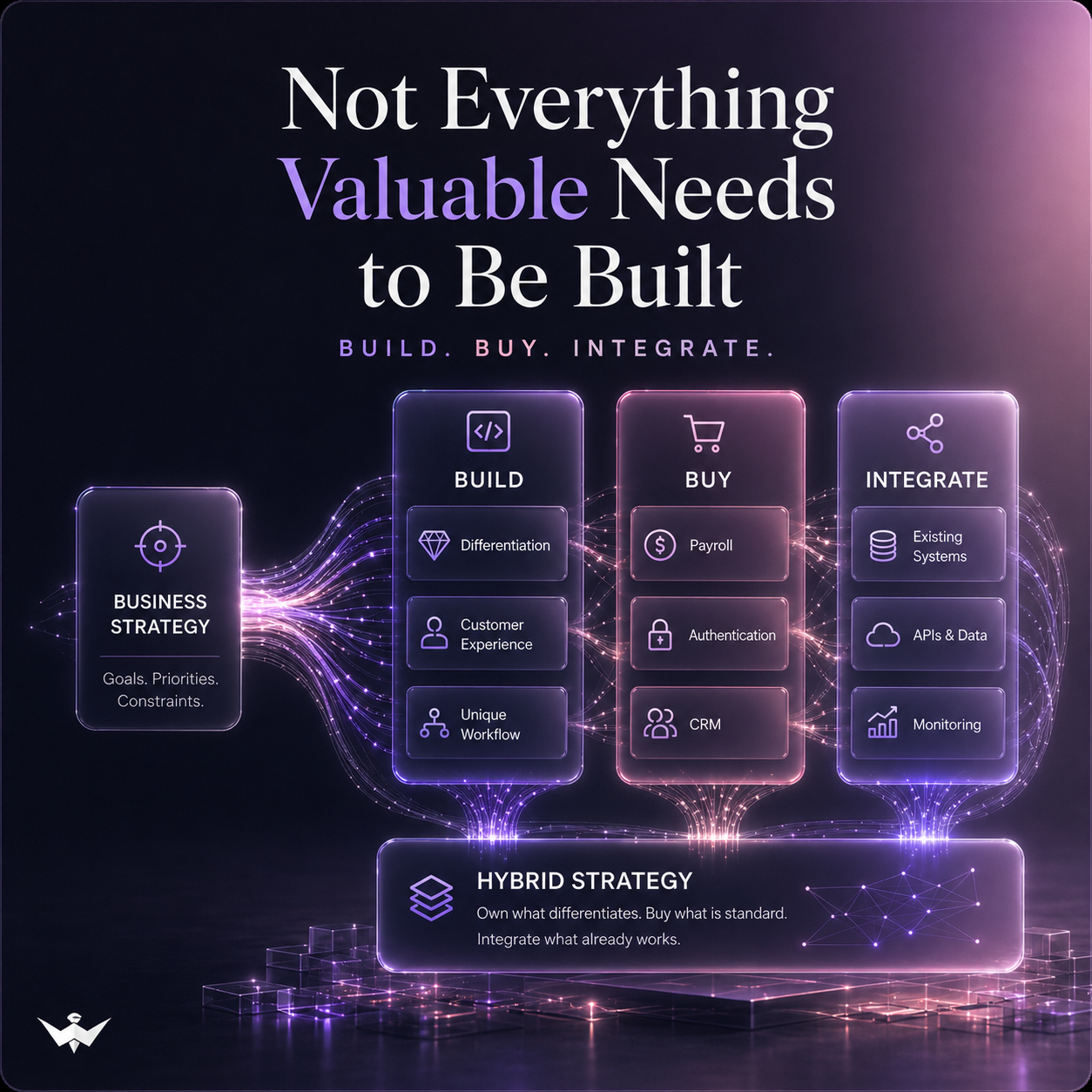
The smartest software strategy is not choosing between build and buy-it is knowing what your business should own, what it should borrow, and what it should connect.