

Championships Are Won in the Garage
Display None Text
What Formula 1 can teach us about building high-performance software architecture that remains fast, reliable, and efficient when the pressure is on.

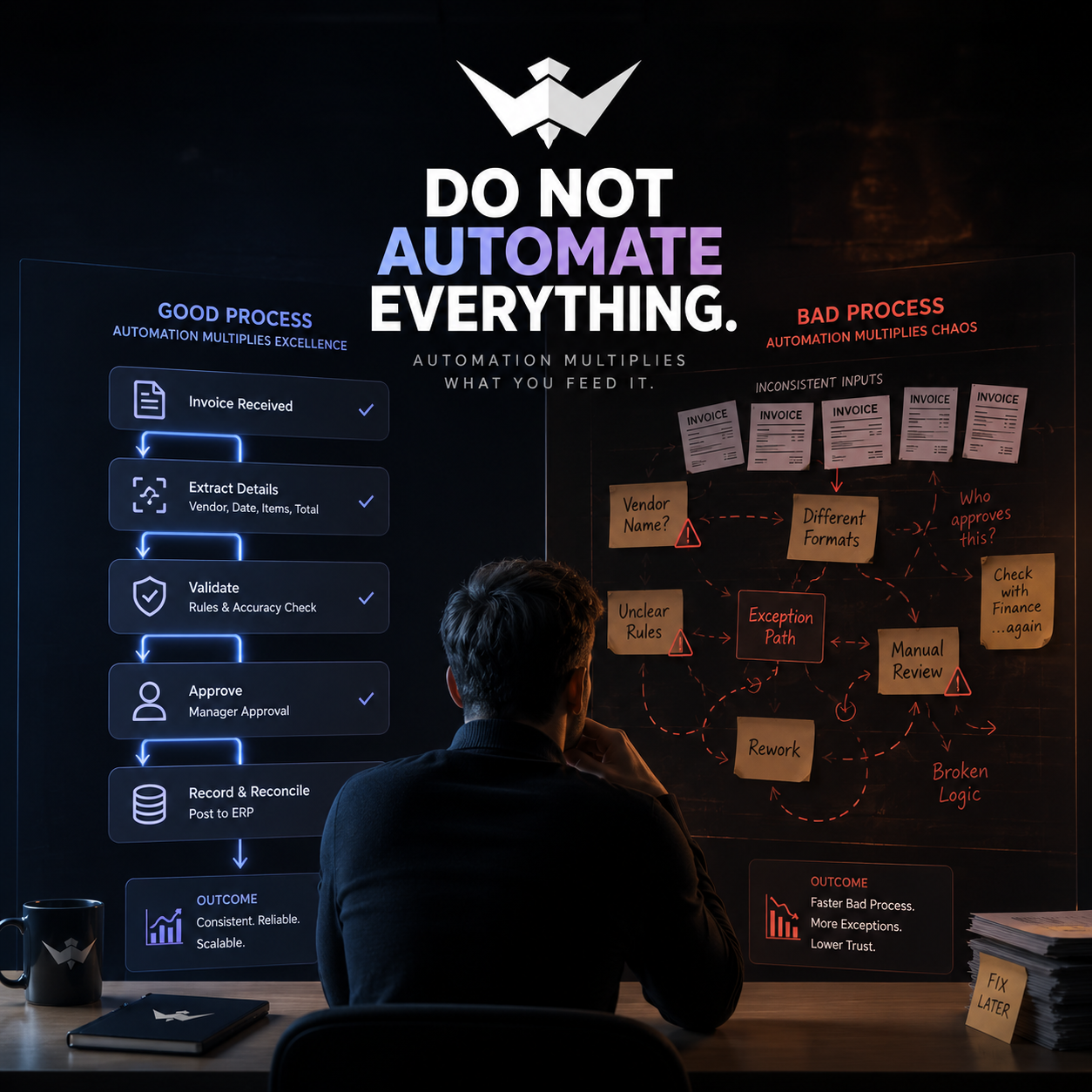
Automation is a multiplier. Before making a process faster, make sure it deserves to be multiplied.



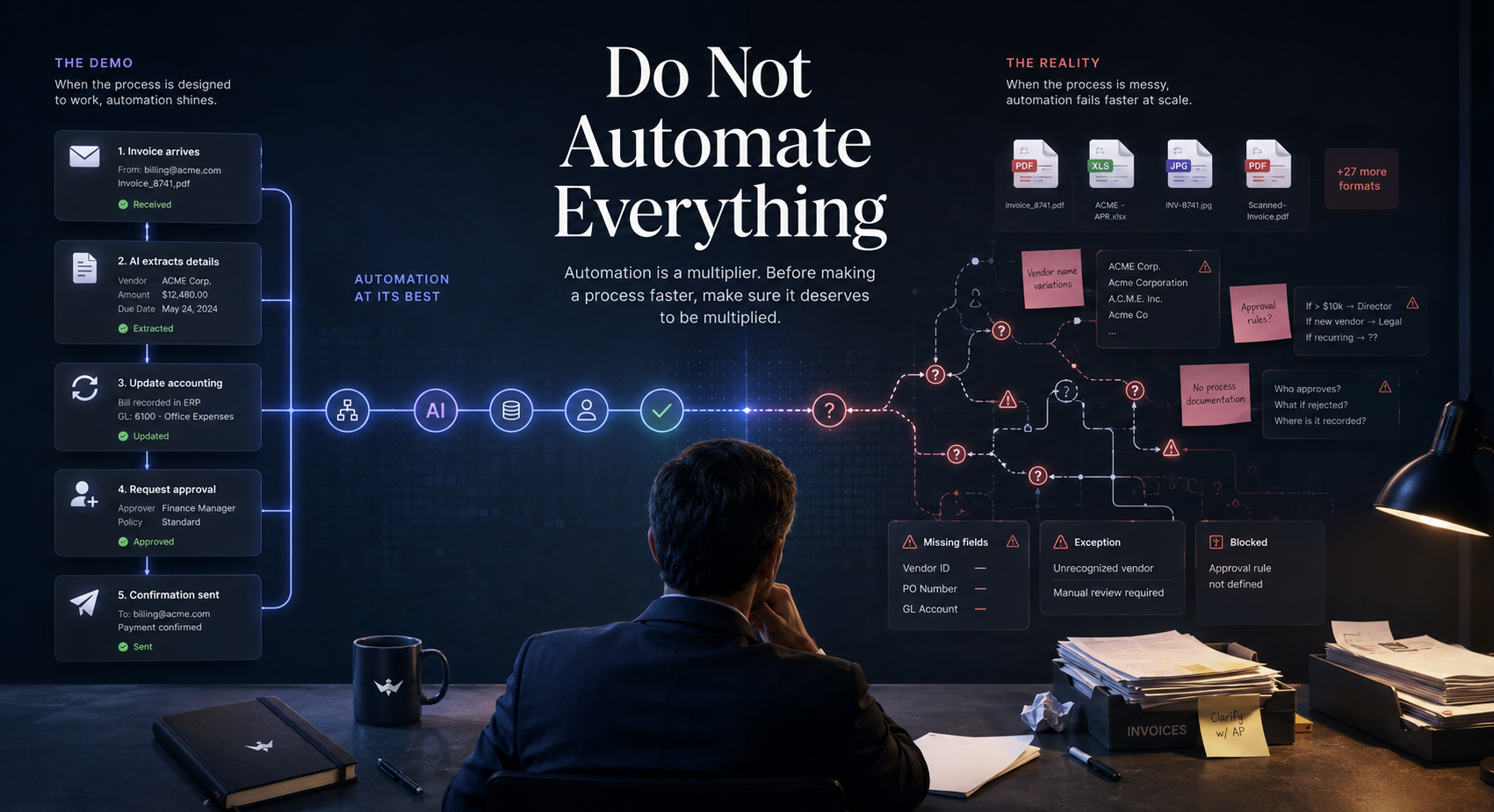
A business leader watches an impressive demonstration.
An invoice arrives by email. AI reads it, extracts the details, updates the accounting system, requests approval, and sends a confirmation-all within seconds.
A few weeks later, the same system is running inside the business. But invoices arrive in different formats. Vendor names do not match internal records. Approval rules are undocumented. Urgent requests follow exceptions known only to experienced employees.
The automation is working.
The process underneath it is not.
Instead of removing friction, the business has created a faster way to generate mistakes.
This is the central truth of business process automation:
A poorly designed workflow does not improve when automated. It simply fails faster and at greater scale.
The right question is not, “What can we automate?”
It is:
Which process should we automate first-and why?
Automation projects often begin with software.
A company discovers a workflow platform, sees an AI demonstration, or decides it needs an agent. The conversation immediately moves toward tools and features.
But before choosing technology, the workflow itself must be understood.
Document:
This exercise often reveals that the “workflow” is really a collection of emails, spreadsheets, informal approvals, and undocumented habits.
That does not mean it cannot be automated.
It means it is not ready yet.
Do not automate a mystery.

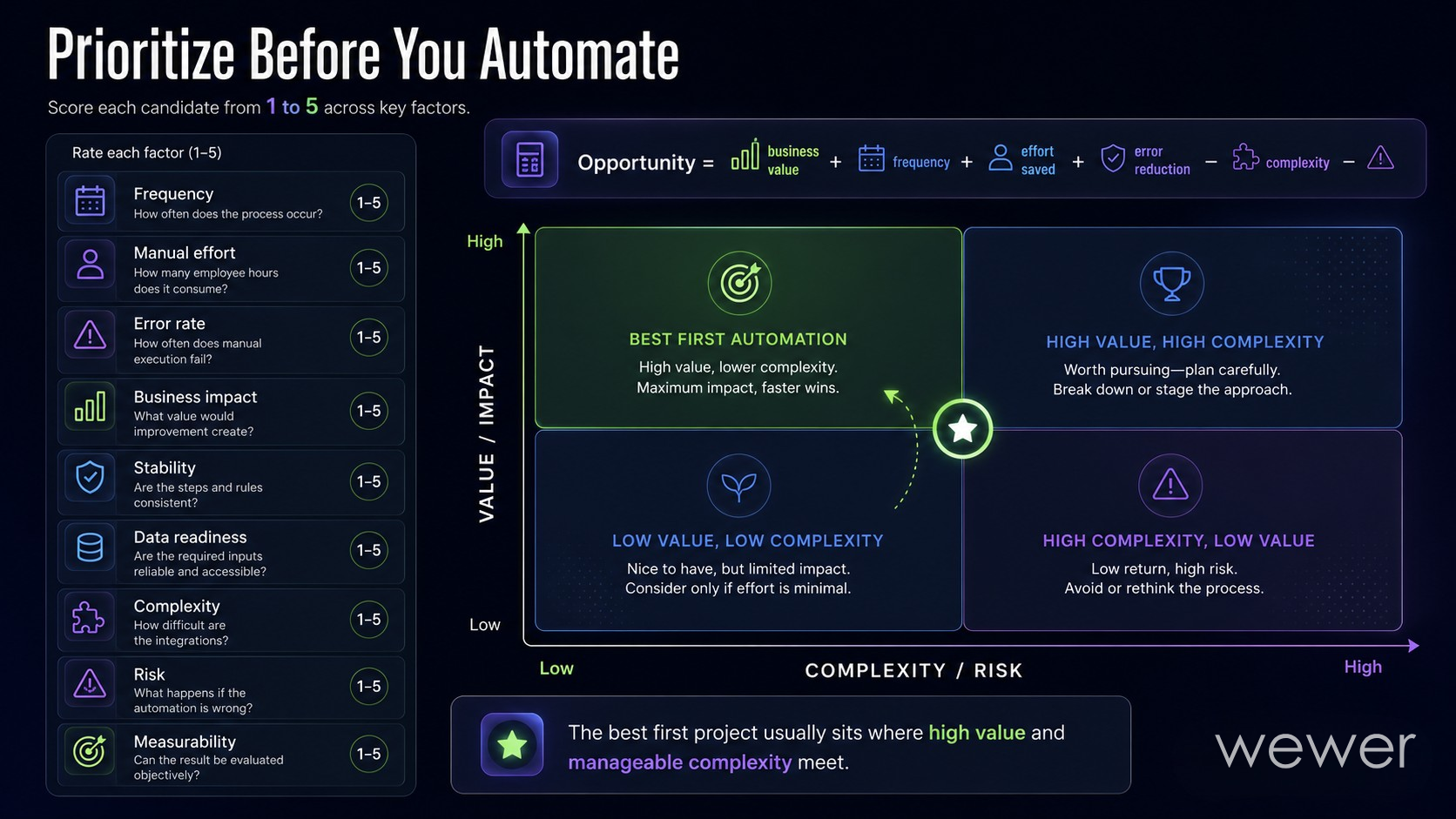
The most valuable processes to automate rarely make the most exciting demonstrations.
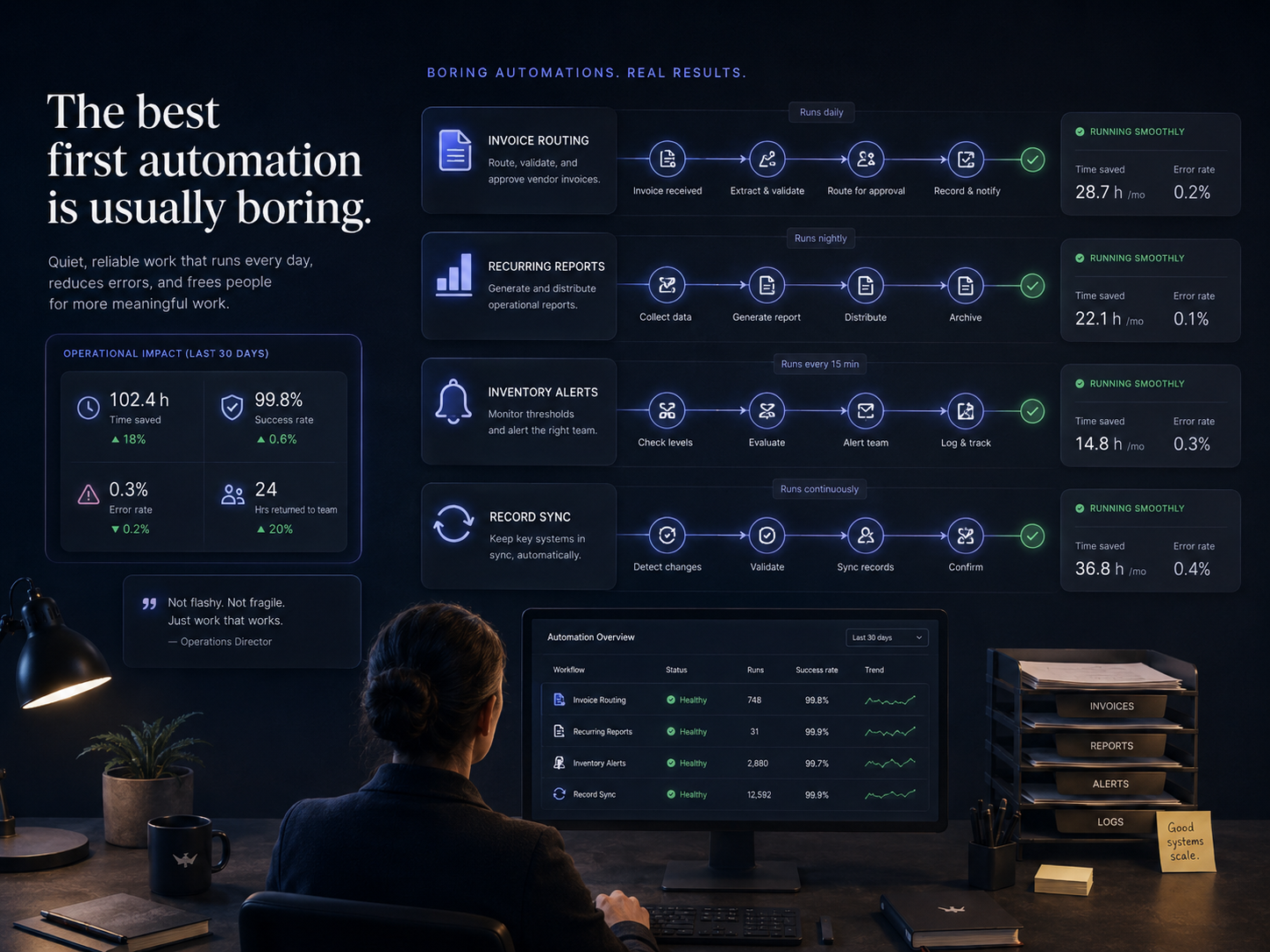
A customer-facing AI agent may attract attention. But automating inventory updates, report preparation, invoice routing, or data synchronization may create far more measurable value.
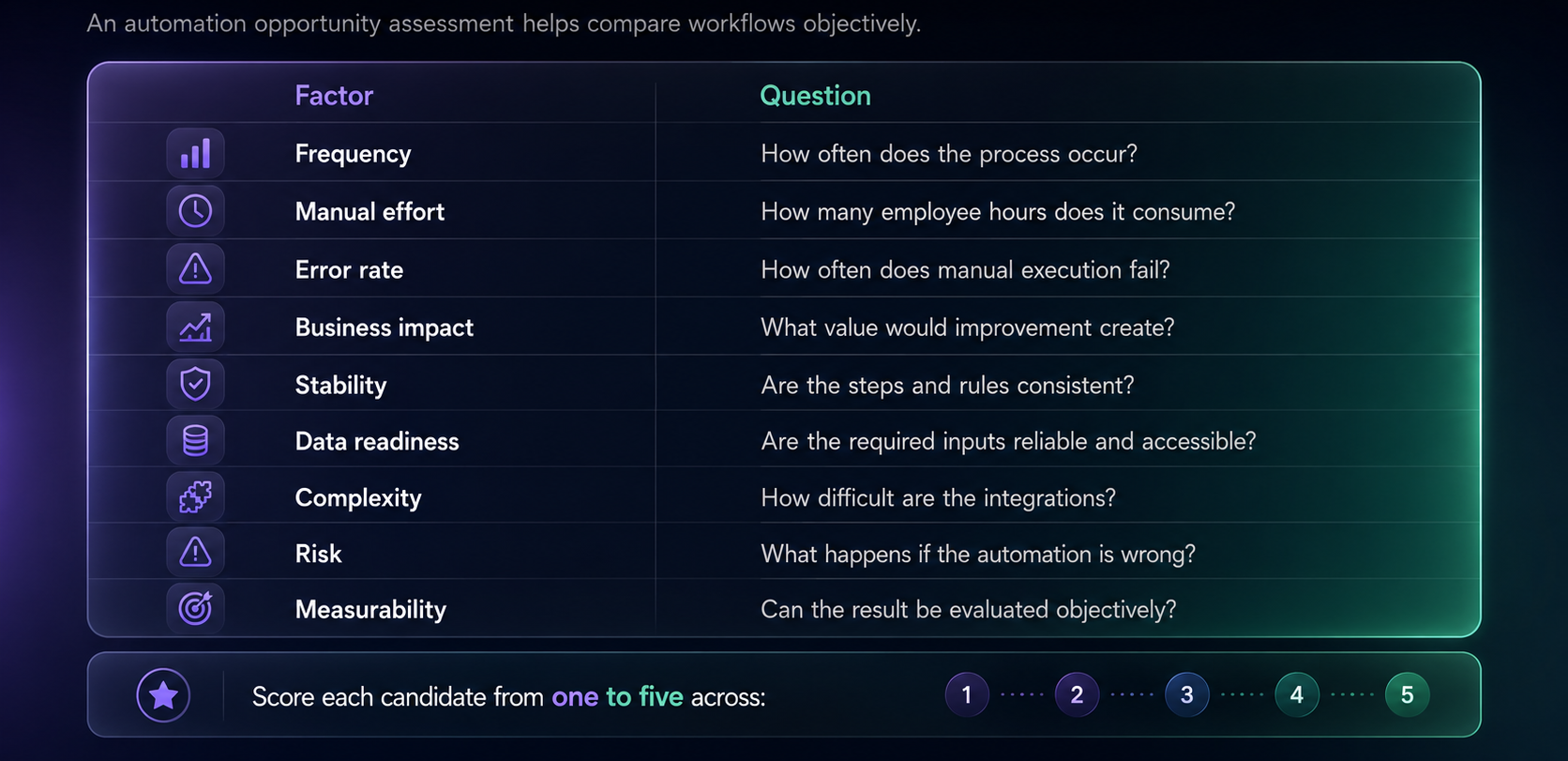
A strong automation candidate is usually:
The best starting point is not necessarily the largest process. It is the one where small improvements compound quickly.
A disciplined business automation strategy also identifies where automation may create more problems than it solves.
Pause when:
There is another possibility.
The process may not need automation at all. It may need removal.
Automating an unnecessary approval does not create efficiency. It preserves bureaucracy in a faster format.
Before building anything, ask:
If we designed the business today, would this workflow still exist?
Not every workflow needs artificial intelligence.
Rule-based automation
Use it when inputs are structured, rules are stable, and outputs must be predictable.
Examples include:
AI-assisted automation
Use it when the workflow involves documents, text, images, classification, summarization, or variable inputs.
AI may extract information, identify intent, summarize content, or recommend the next step while leaving the final decision to a person.
Agentic automation
Use it when a goal requires several coordinated actions across multiple systems.
An agent may gather information, choose tools, evaluate intermediate results, and adjust its path. That flexibility also increases risk, so permissions, approval points, monitoring, and rollback must be clearly defined.
Human involvement is not always a temporary weakness.
It may remain necessary for:
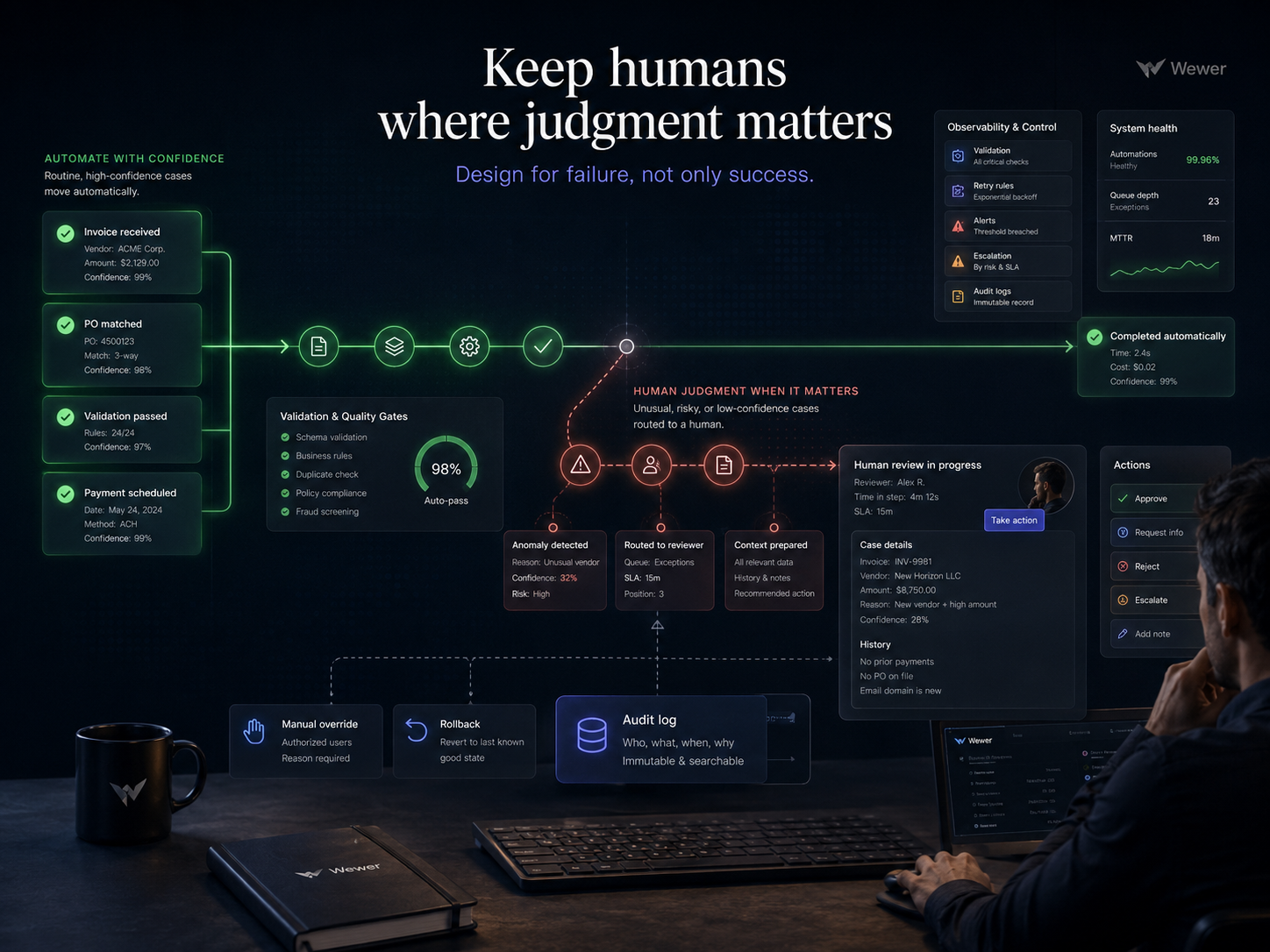
A good human-in-the-loop process does not send everything for review.
Routine, high-confidence cases should move automatically. Uncertain or high-risk cases should reach the right person with the relevant context already prepared.
The goal is not to eliminate judgment.
It is to stop wasting judgment on work that never required it.
A demonstration proves that a workflow can work once.
A pilot proves that it can survive ordinary business conditions.
A good pilot should have:
For Deko Automotive, value existed across inventory, logistics, delivery communication, and operational-data workflows. The opportunity was not one impressive AI feature. It was connecting information to the movement of the business.
Similarly, coordinating data ingestion across more than 75 sources for MetaWorldX required dependable integration and orchestration before more advanced automation could deliver value.
Reliable automation begins with reliable foundations.
Most demonstrations show the happy path.
Production systems face missing data, duplicate requests, timeouts, changed APIs, unclear documents, and conflicting records.
A dependable automation needs:
The quality of an automation is not revealed when everything works.
It is revealed by what happens when something does not.
After launch, compare results against the original baseline.
Track:
“Tasks automated” is not a business result.
One workflow that removes a recurring bottleneck may create more value than dozens of automations that save a few clicks.
Scale only after the pilot is stable and standards for governance, security, monitoring, documentation, and ownership are in place.
The first automation should not be selected because it looks futuristic.
It should be selected because the process consumes measurable time, creates repeated friction, follows a stable pattern, and can be improved without introducing unacceptable risk.
Understand the workflow. Measure its cost. Decide where rules are sufficient, where AI adds value, and where human accountability must remain.
Then automate it carefully.
The best first automation may never look revolutionary.
It may simply make inventory more accurate, reports arrive on time, customers receive faster answers, and employees stop copying the same information between the same systems every morning.
Inside a business, that is often revolutionary enough.

What Formula 1 can teach us about building high-performance software architecture that remains fast, reliable, and efficient when the pressure is on.
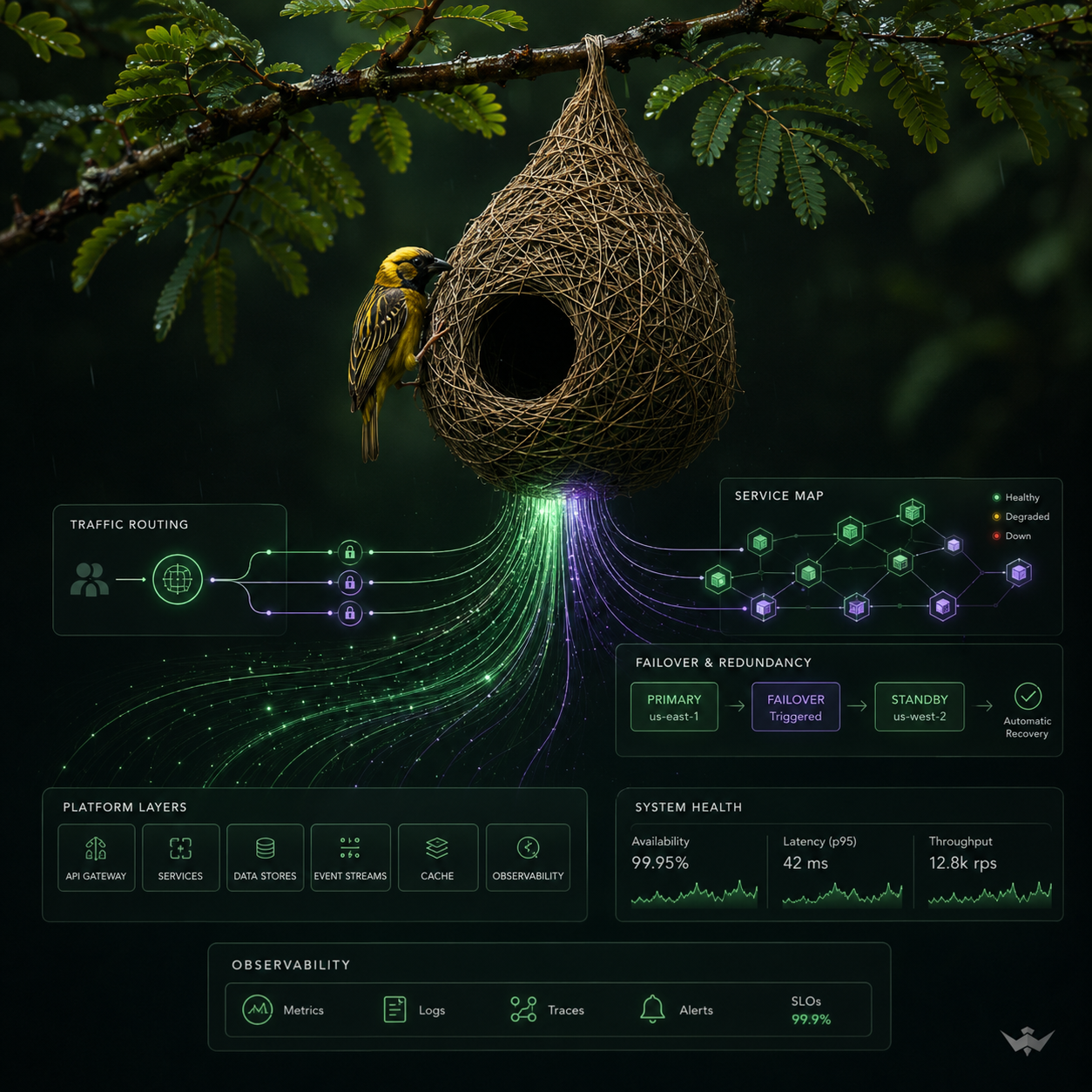
The strongest systems are rarely made from extraordinary parts. They become extraordinary through the way those parts are connected.

The real test of an AI system begins when the perfect prompt, curated data, and friendly audience disappear.
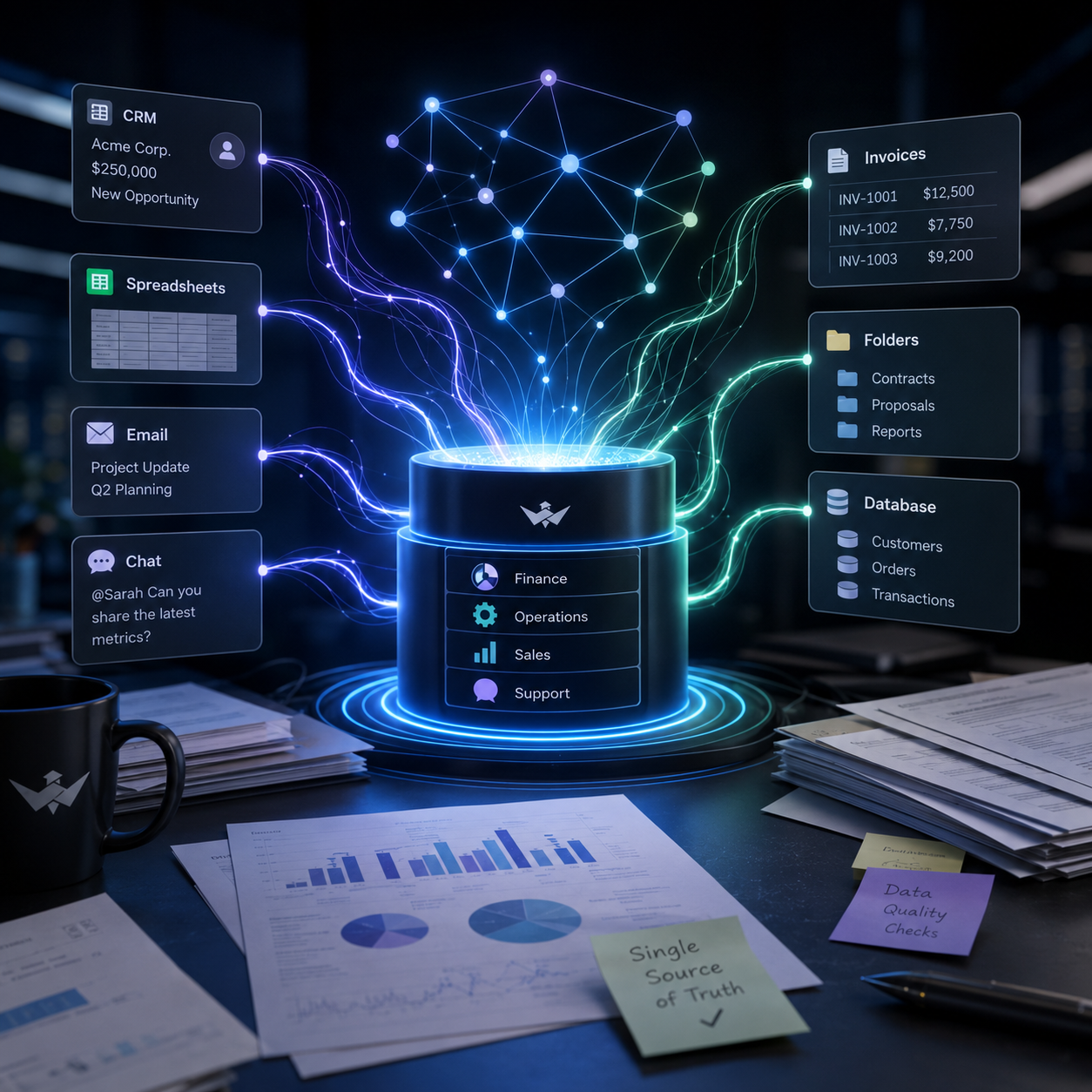
Before AI can understand your business, your business has to understand where its knowledge lives.
Automation is a multiplier. Before making a process faster, make sure it deserves to be multiplied.

We learned to talk to artificial intelligence. Now we are teaching it how to move work forward.
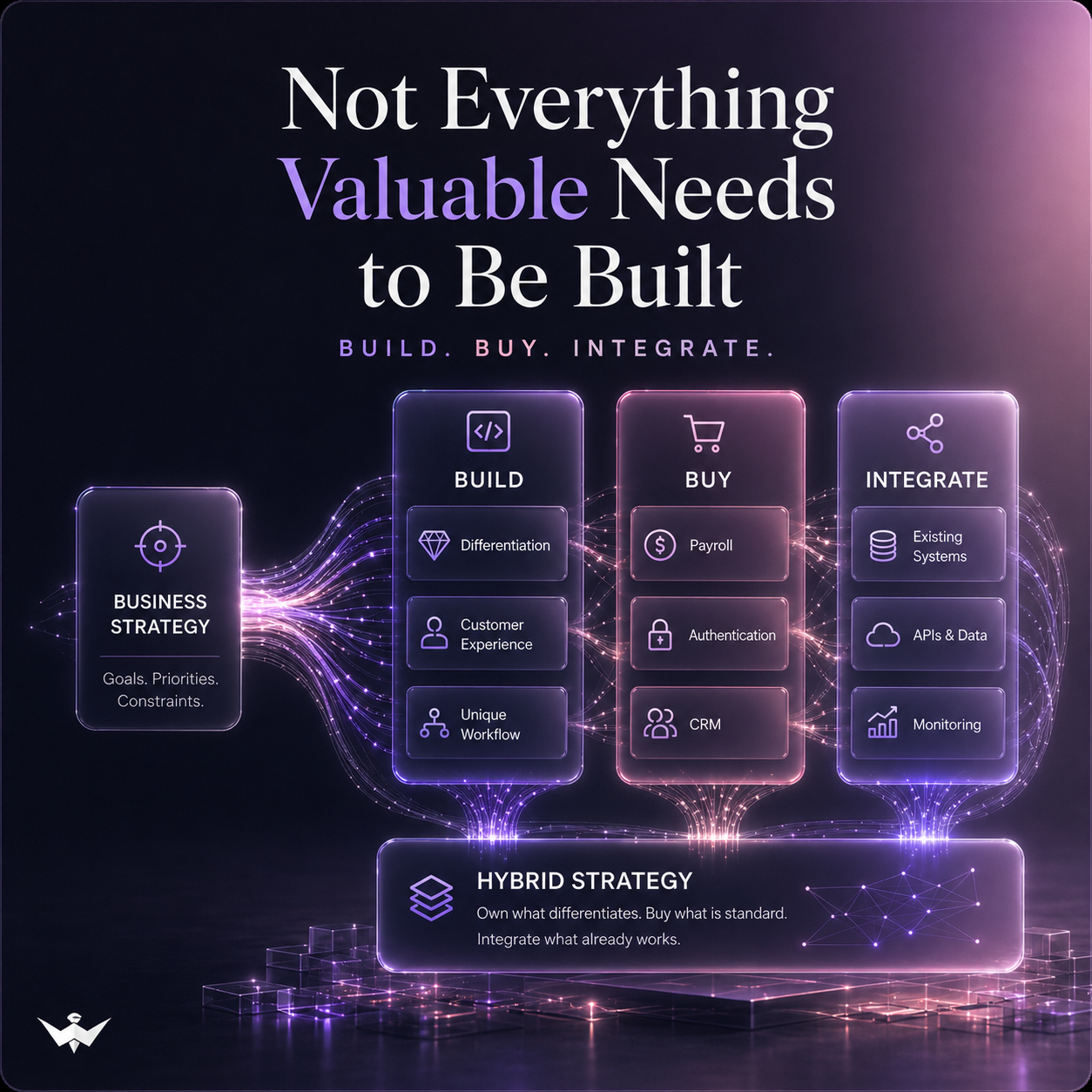
The smartest software strategy is not choosing between build and buy-it is knowing what your business should own, what it should borrow, and what it should connect.